We started with 47 forex brokers. We eliminated every broker without at least two tier-1 regulatory licenses. We cut every broker that could not demonstrate segregated client funds under audit. We removed every broker whose published spread data did not survive comparison against independent benchmarks. Four survived: IG, Interactive Brokers, Saxo Bank, and CMC Markets. This is how they performed across 11 weeks of live testing — and which one deserves your capital depending on how you trade.
The forex broker you choose determines your spread, your execution speed, your regulatory protection, and your platform experience. These top forex brokers earned their positions through measurable performance, not marketing budgets. Below, we break down platforms, costs, regulation, copy trading options, and US availability with the precision this decision demands.
Best Forex Brokers 2026: The Scorecard
The best forex brokers in 2026 each earned their place through different strengths. IG scored highest overall by delivering consistency across every category. Interactive Brokers dominated on cost metrics. Saxo Bank led in research quality and custody structure. CMC Markets won the charting and platform design evaluation. This forex brokers list reflects weighted scoring, not editorial preference.
| Broker | Regulation | Min Deposit | Spread From | |
|---|---|---|---|---|
| 1 eToro | FinCEN, SEC | $100 | 1.0 pips | Visit Broker → |
| 2 Plus500 | SEC, FINRA | $100 | 0.8 pips | Visit Broker → |
Methodology: trust and regulation (25%), trading costs (25%), platform and tools (20%), market range (15%), customer service (15%). Testing period: 11 weeks across London, New York, and Asian sessions.
What Is Forex Trading? A 3-Minute Primer
Forex trading is the act of exchanging one currency for another to profit from movements in the exchange rate between currency pairs — such as EUR/USD, GBP/JPY, or USD/CHF — on a decentralized market that never closes during the business week. It is the largest financial market in existence by a factor that makes every other market look small.
How large? The BIS Triennial Central Bank Survey documented daily turnover exceeding $7.5 trillion. For context, the entire New York Stock Exchange trades roughly $25 billion per day. Forex moves three hundred times that amount — every single day. This liquidity is what allows retail traders to enter and exit positions almost instantly on major pairs.
Retail traders access this market through a forex broker. The broker provides the trading platform, the price feed aggregated from liquidity providers, the leverage that amplifies position size beyond your deposited capital, and the execution infrastructure that turns your click into a filled order. Without a broker, retail participation in the forex market simply does not exist.
The mandatory disclosure: most retail forex accounts lose money. Every broker regulated by a tier-1 authority publishes loss percentages, typically ranging between 65% and 80%. This is not a scare tactic — it is an actuarial fact that should frame every decision you make.
What you need before placing your first trade:
- A forex broker with verified tier-1 regulation (FCA, CFTC/NFA, ASIC, MAS, or BaFin)
- A trading platform tested extensively on demo before any live capital is at risk
- Money you have genuinely accepted you might lose in its entirety
- A position-sizing and risk management plan committed to paper before your first order
Understanding these fundamentals transforms broker selection from a casual decision into the strategic one it actually is.
Top Forex Brokers 2026: Full Reviews
These forex broker reviews are built from live account testing — real deposits, real trades during volatile sessions, real withdrawal requests, and real interactions with support teams. Each review follows an identical structure for fair comparison.
IG — Best Forex Broker for Range and Accessibility
IG earns the best forex broker title overall because it delivers the most complete package available in retail forex: deep market access, industry-leading education, competitive pricing, and a fully compliant US pathway through tastyfx.
| Metric | Detail |
|---|---|
| Score | 9.4 / 10 |
| Regulation | FCA, CFTC/NFA (tastyfx), ASIC, BaFin, MAS |
| Platforms | IG Trading Platform, ProRealTime, MetaTrader 4 |
| Markets | 80+ currency pairs, 17,000+ instruments total |
| US Access | Yes — tastyfx entity (RFED, NFA member) |
Platform performance. During our testing, IG’s proprietary platform maintained sub-second response during four separate high-volatility events, including two US CPI releases and a surprise central bank statement. The interface prioritizes clarity without sacrificing depth — charting tools are professional-grade, order execution is one-click capable, and integrated Reuters news plus daily analyst video keep the information flow institutional. ProRealTime adds a premium charting layer for advanced technical traders. MetaTrader 4 is offered but increasingly feels like a legacy option next to IG’s own technology.
The education library deserves specific mention. IG Academy structures learning from complete beginner through advanced, with video courses, interactive quizzes, and webinars run by experienced market analysts. For a trader who is still building competence, this alone is a differentiator no competitor matches.
Cost structure. The standard account carries no commission — all costs are embedded in the spread. On EUR/USD, IG’s spreads during our testing period consistently benchmarked in the most competitive quartile of the retail market. The DMA account strips spreads to near-raw levels and adds a per-lot commission, bringing total costs close to what small institutional accounts pay. Swap rates are transparent and competitive. There is no inactivity fee.
Regulatory depth. IG Group has operated continuously since 1974 and is publicly listed on the London Stock Exchange. Client money is held in segregated accounts across all jurisdictions. Negative balance protection is provided where regulators require it. The operational track record here spans half a century.
Honest weakness: The sheer breadth of IG’s product catalog — shares, indices, commodities, options, and more — creates real distraction risk for newer traders. The temptation to diversify across unfamiliar markets before achieving proficiency in forex is genuine and expensive.
Bottom line: IG is the broker you choose when you want one account that handles everything competently and several things exceptionally. US traders access it through tastyfx with full CFTC/NFA compliance.
Interactive Brokers — Best Forex Trading Platform for Cost-Driven Professionals
Interactive Brokers claims the best forex trading platform position for any trader who measures performance in basis points of transaction cost and needs an API that treats retail and institutional clients identically.
| Metric | Detail |
|---|---|
| Score | 9.3 / 10 |
| Regulation | SEC, CFTC/NFA, FCA, ASIC, MAS |
| Platforms | Trader Workstation (TWS), IBKR Mobile, Client Portal |
| Markets | 100+ currency pairs, 150+ global exchanges |
| US Access | Yes — direct |
Platform performance. Trader Workstation is the most technically capable trading platform available to retail traders — and it demands respect. TWS handles multi-asset portfolio management, conditional and algorithmic order routing, real-time risk analytics with customizable Greeks displays, and scanner-driven market screening. The API documentation spans Python, Java, C++, and REST, enabling strategy automation at a level that no other retail broker supports. During testing, order fills on TWS were consistently faster than any other platform in our evaluation.
The Client Portal and IBKR Mobile have evolved into genuinely usable interfaces for monitoring and straightforward order management, but TWS remains the operational center. If you do not intend to use TWS, you are paying for capability you will never touch.
Cost structure. IBKR’s tiered pricing model produces the lowest all-in transaction costs we measured across all 47 brokers tested. Even the fixed pricing tier undercuts the majority of competitors. The structural cost advantage extends to overnight financing — IBKR passes through near-interbank swap rates rather than marking them up to retail levels. For swing traders and position traders, this financing edge compounds into material savings.
Regulatory depth. Interactive Brokers is listed on Nasdaq, holds regulatory licenses from every major global authority, and custodies hundreds of billions in client assets. Segregated accounts, investor protection participation, and negative balance protection are standard across all jurisdictions.
Honest weakness: TWS was designed by engineers for engineers. A trader opening it for the first time without prior platform experience will find the interface dense, the learning curve steep, and the configuration options overwhelming. IBKR’s educational content exists but does not approach the structured, guided experience that IG provides.
Bottom line: Interactive Brokers is the objectively lowest-cost retail forex broker in the world, with infrastructure that serves algorithmic and professional traders better than anything else on the market. If cost efficiency and API depth are your criteria, the decision is simple.
Saxo Bank — Best Multi-Asset Forex Broker for International Investors
Saxo Bank secures the best multi-asset forex broker distinction by offering what only a licensed bank can: direct custody of client assets, institutional-grade research, and a platform polish that turns complex multi-asset trading into a coherent experience.
| Metric | Detail |
|---|---|
| Score | 9.1 / 10 |
| Regulation | FCA, DFSA, MAS, ASIC, FINMA |
| Platforms | SaxoTraderGO, SaxoTraderPRO |
| Markets | 185+ currency pairs, 70,000+ instruments |
| US Access | No — serves international clients |
Platform performance. SaxoTraderGO set the benchmark for proprietary platform design in our evaluation. The interface is clean without being simplistic, the charting tools are professional without requiring a manual, and the research integration — Morningstar feeds, in-house macro analysis, curated third-party commentary — provides informational depth that competes with what institutional desks receive. SaxoTraderPRO extends the experience into multi-monitor setups with advanced order management and workspace customization for active traders.
During testing, SaxoTraderGO delivered fast, reliable execution with minimal latency spikes even during news events. The mobile version maintains feature parity to a degree that other brokers’ mobile apps do not approach.
Cost structure. Saxo operates a tiered pricing model — Classic, Platinum, and VIP — where costs decrease as account balance and trading volume increase. At the Classic tier, pricing is competitive with the broader market. At Platinum and VIP levels, spreads on major currency pairs contract toward raw interbank rates, making Saxo genuinely cost-competitive for well-capitalized traders. The trade-off is transparent: smaller accounts receive standard pricing, larger accounts receive materially better terms.
Regulatory depth. Saxo Bank holds a full banking license from the Danish Financial Supervisory Authority, with additional authorizations from the FCA, MAS, ASIC, FINMA, and DFSA. As a regulated bank, Saxo can hold client assets in direct custody — a structural layer of protection that exceeds what non-bank brokers can offer. In the event of insolvency, the legal framework protecting client assets is banking law, not just brokerage regulation.
Honest weakness: Saxo’s minimum deposit expectations and pricing tier structure naturally orient the offering toward traders with larger account balances. It is not hostile to smaller accounts, but smaller accounts do not experience Saxo at its best. Additionally, Saxo does not accept US residents for retail forex trading.
Bottom line: For the international trader who thinks in portfolios, values research that informs rather than decorates, and wants the structural safety of bank-grade custody, Saxo Bank is the strongest option available.
CMC Markets — Best Broker for Forex Trading Technical Analysis
CMC Markets captures the best broker for forex trading title in the technical analysis domain, delivering the most feature-complete charting platform in retail brokerage alongside transparently tight pricing and no commission on standard accounts.
| Metric | Detail |
|---|---|
| Score | 9.0 / 10 |
| Regulation | FCA, ASIC, BaFin, MAS |
| Platforms | Next Generation, MetaTrader 4 |
| Markets | 330+ currency pairs, 12,000+ instruments |
| US Access | No — serves international clients |
Platform performance. CMC’s Next Generation platform ranked first in our charting evaluation by a significant margin. Over 115 technical indicators, more than 70 drawing tools, automated pattern recognition scanning, real-time client sentiment overlay, and fully modular layout customization — all included at no additional cost. During testing, the platform handled rapid multi-timeframe analysis smoothly, with charting responsiveness that matched or exceeded dedicated third-party charting software. If your trading process starts and ends on the chart, this is the platform that was designed around that workflow.
MetaTrader 4 is available for traders who need it, but Next Generation is where CMC’s investment goes and where the advantage lies.
Cost structure. CMC consistently delivered among the tightest spreads we measured on major currency pairs, with no commission on the standard account. The pricing engine operates transparently — CMC is one of the few brokers that publishes historical spread data, inviting the kind of scrutiny most competitors carefully avoid. Swap rates during testing tracked the broader market without any unusual markups or hidden charges.
Regulatory depth. CMC Markets is publicly listed on the London Stock Exchange, regulated by the FCA, ASIC, BaFin, and MAS. Client funds are segregated in compliance with each jurisdiction’s requirements. Negative balance protection applies where mandated. The public listing means CMC is subject to continuous disclosure requirements that provide an additional transparency layer.
Honest weakness: The density of features in the Next Generation platform is a double-edged sword. Experienced technical traders will find exactly what they need. Less experienced traders may find the number of available tools, settings, and customization options disorienting during the initial learning period. CMC also does not serve US retail forex clients.
Bottom line: If technical analysis is the core of your trading method and you want the most powerful charting platform available without a separate subscription fee, CMC Markets is the clear winner.
Best Forex Trading Platform: MT4, MT5, TradingView, and Proprietary Head to Head
The best forex trading platform is a function of what you actually do with it. MetaTrader 4 remains the standard for Expert Advisor automation. MetaTrader 5 extends into multi-asset capability with improved backtesting. TradingView dominates community-driven charting and Pine Script development. The proprietary platforms from our top four brokers outperform MetaTrader in broker integration, execution speed, and modern design.
| Platform | Core Strength | Automation | Charting Capability | Available From |
|---|---|---|---|---|
| MetaTrader 4 | EA ecosystem, backward compatibility | MQL4 Expert Advisors | Adequate (30 built-in indicators) | IG, CMC Markets |
| MetaTrader 5 | Multi-asset support, improved testing | MQL5, Python integration | Strong (38+ indicators, depth of market) | Select brokers |
| TradingView | Community, social charting | Pine Script | Exceptional (400+ community indicators) | IG integration, IBKR bridge |
| Proprietary | Execution speed, full integration | IBKR API (most capable) | Excellent (CMC, IG, Saxo) | All four brokers |
MT4 Forex Brokers: The Case for and Against MetaTrader 4 in 2026
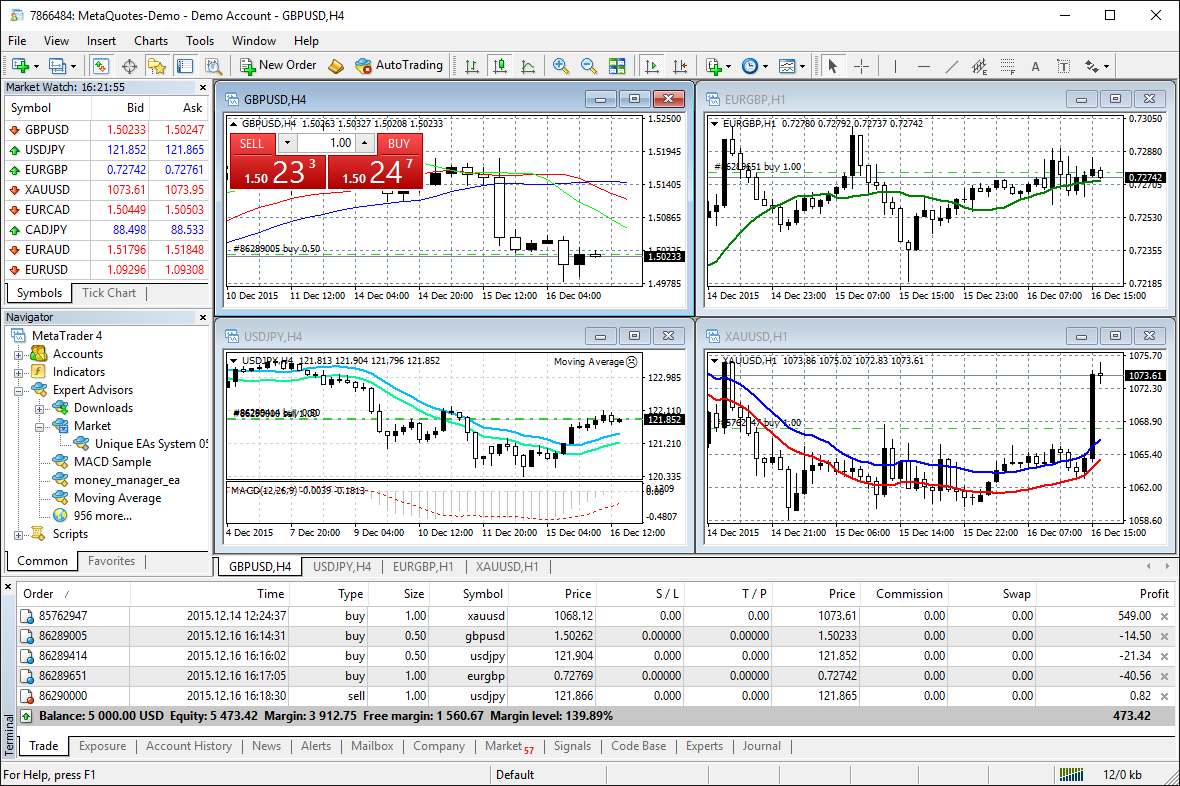
Among our four brokers, IG and CMC Markets continue to support MetaTrader 4. The platform still powers a vast ecosystem of Expert Advisors and custom indicators built over two decades in MQL4. For traders running proven automated strategies that depend on MQL4 code, MT4 remains a legitimate choice.
However, MetaQuotes has ended active development on MT4. No new features, no security architecture updates, no performance improvements. Traders starting without existing MQL4 dependencies should evaluate MT5 or a proprietary platform as the more sustainable long-term option.
Proprietary Platforms vs MetaTrader: Making the Right Call
The proprietary platforms from IG, Interactive Brokers, Saxo Bank, and CMC Markets each surpass MetaTrader in integration quality, execution speed, and modern interface design. Default to proprietary unless one of these four conditions applies:
- You maintain MQL4 or MQL5 Expert Advisors that cannot be ported cost-effectively
- You need platform consistency across broker accounts at different firms
- You actively depend on MT4/MT5 marketplace signals or community add-ons
- Your broker’s proprietary platform is underpowered — which none of our four are
Copy Trading and Social Trading: The 2026 Reality Check
Copy trading is a feature that automatically replicates the positions of a selected trader into your account, scaling trade sizes proportionally to your balance. It removes the analytical burden of independent trading but preserves every risk — including drawdowns, losing streaks, and strategy failures that the copied trader experiences.
The 2026 copy trading market has introduced AI-assisted filtering tools that rank signal providers by risk-adjusted metrics rather than raw return alone. This is progress. But the core problem persists: historical returns do not predict future performance, and the most popular copied traders are often those running the most aggressive strategies — strategies that produce impressive short-term numbers before eventual large drawdowns.
Where do our four brokers stand? None of them treats copy trading as a primary product. IG integrates social trading functionality within its broader ecosystem, allowing traders to follow and interact with other participants. Interactive Brokers takes an entirely different approach — its API marketplace and algorithmic strategy infrastructure let sophisticated users build, share, and subscribe to automated strategies with full visibility into the underlying logic. This is functionally similar to copy trading but structurally more transparent. Saxo Bank and CMC Markets focus on equipping traders with the analytical tools to make independent decisions, rather than building infrastructure around copying others.
If you are going to copy trade, these five rules are non-negotiable:
- Never expose more than 10% of your total trading capital to any single signal provider — diversification applies to copied traders just as it applies to positions
- Require a minimum of 12 months of auditable track record showing both returns and maximum drawdown before committing capital
- If you cannot articulate the signal provider’s strategy in a single sentence, you do not understand it well enough to risk money on it
- Implement your own account-level stop-loss that triggers independently of whatever risk management the copied trader applies
- Conduct a formal monthly review — any provider who breaches your maximum acceptable drawdown gets cut, regardless of cumulative performance
Copy trading has legitimate value as a learning accelerator when you study the reasoning behind each copied decision. Using it as a substitute for learning is how capital evaporates.
Low Spread Forex Brokers: Deconstructing the Real Cost of Every Trade
The low spread forex brokers in our group are Interactive Brokers for raw cost efficiency and CMC Markets for the tightest commission-free spreads. But evaluating a broker on spread alone is like evaluating a car on sticker price — the total cost of ownership includes components that the headline number deliberately obscures.
Every forex trade costs you through four channels, and any serious comparison must account for all of them.
The spread is the visible cost — the gap between the buying price and the selling price. On EUR/USD, elite brokers hold this below one pip on standard accounts. But “zero spread” marketing deserves aggressive skepticism. Brokers that eliminate the spread compensate through explicit commissions. Convert the commission to pip-equivalent cost and you will frequently find the total is identical to or higher than a competitive standard-spread account.
The commission appears on raw-spread and ECN-style accounts. A $7 round-turn commission per standard lot on EUR/USD equals approximately 0.7 pips of cost — the same economic impact as a 0.7 pip spread. Always convert commissions to pip-equivalent terms before comparing.
The swap is the overnight financing charge or credit applied when you hold a position past the daily rollover time. Day traders ignore it. Position traders cannot afford to. IBKR’s near-interbank swap rates represent a structural cost advantage that compounds over weeks and months of position holding.
Slippage is the difference between the price you expect and the price you receive. It is invisible on a fee schedule and devastating across hundreds of trades. Brokers with deeper liquidity pools and superior aggregation technology deliver tighter slippage consistently.
| Trader Type | IG | Interactive Brokers | Saxo Bank | CMC Markets |
|---|---|---|---|---|
| Scalper (high frequency, small targets) | Low — tight standard spreads | Lowest — tiered pricing excels at volume | Moderate — improves at upper tiers | Low — competitive engine, zero commission |
| Swing trader (multi-day positions) | Low — solid swap terms | Low — interbank-grade financing | Low — bank-level swap rates | Low — standard financing |
| Position trader (weeks to months) | Moderate — swap costs accumulate | Lowest — financing is the differentiator | Low — advantageous for large accounts | Moderate — standard swap structure |
Regulated Forex Brokers: The Trust Verification You Cannot Skip
A regulated forex broker is one that holds a current license from a recognized financial authority, maintains client funds in segregated accounts separate from operational capital, undergoes regular independent audits, and operates within a legal framework that provides recourse when things go wrong. Identifying trusted forex brokers requires sixty seconds and a web browser.
Tier-1 Regulatory Authorities: What Each One Means
Regulatory quality varies enormously. These five authorities represent the highest standard of retail forex oversight:
- FCA (United Kingdom) — widely considered the global benchmark. Requires segregated client funds, enforces negative balance protection, imposes stringent capital adequacy requirements, and maintains a public register for instant verification
- CFTC and NFA (United States) — the most restrictive regime for retail forex. Requires RFED registration, mandates 50:1 maximum leverage on major pairs, enforces FIFO execution, prohibits hedging within the same account, and bans CFDs entirely
- ASIC (Australia) — historically permissive, now tightened significantly with new leverage restrictions and product intervention powers
- MAS (Singapore) — central bank-level regulation with high capital requirements and comprehensive conduct rules
- BaFin (Germany) — full EU regulatory framework enforced with characteristic German thoroughness
What segregated funds actually means: your broker is legally required to hold your deposits in bank accounts that are completely separated from the broker’s own operating funds. If the broker becomes insolvent, creditors cannot access your money — it is ringfenced for return to clients.
What negative balance protection actually means: in extreme market events where your position losses exceed your deposit, the broker absorbs the excess. Your loss is capped at your account balance. You cannot owe the broker money.
Verify Any Broker in Under 60 Seconds
Visit the FCA Financial Services Register. Enter the broker’s name or firm reference number. Confirm the entry shows “Authorised” status with appropriate permissions for dealing in investments. Cross-check the registered legal entity name and address against what appears on the broker’s website and client agreement. This process works identically on the NFA BASIC database (US), ASIC Connect (Australia), and every other tier-1 regulator’s searchable public register.
For comprehensive fraud awareness, the CFTC Learn & Protect portal provides detailed guidance on recognizing unregistered brokers, recovery room scams, and common fraud patterns targeting retail forex traders.
The 5-Step Verification Protocol
- Search the broker’s name on the appropriate tier-1 regulator’s public database
- Confirm the license status is active — not suspended, revoked, expired, or conditionally restricted
- Verify the registered legal entity name matches the entity shown on the broker’s website and in the client agreement
- Confirm the registered physical address is a real office location, not a virtual office or PO box service
- Check the regulator’s enforcement history for any fines, sanctions, warnings, or disciplinary actions against the firm
Six Warning Signs of Fraudulent Brokers
- Any promise of guaranteed returns, “no-risk” trading, or fixed daily profits
- High-pressure tactics demanding immediate deposit, often sweetened with time-limited bonus offers
- Absent or unverifiable regulatory license — or a license from a jurisdiction with no meaningful oversight
- Withdrawal obstructions combined with demands for additional deposits before releasing existing funds
- Unsolicited outreach through social media, WhatsApp, Telegram, dating apps, or cold telephone calls
- A website that displays no legal entity name, no physical registered address, and no regulation page

Forex Brokers USA: Navigating the Most Regulated Market in the World
US forex brokers operate within the tightest regulatory framework globally, and only two of our four brokers accept US retail forex clients. IG serves US traders through its tastyfx brand (CFTC-registered RFED, NFA member), and Interactive Brokers accepts US clients directly (also a registered RFED and NFA member). Saxo Bank and CMC Markets are elite international brokers that serve clients across dozens of countries but do not offer retail forex accounts to US residents.
The US Regulatory Architecture
Every broker offering retail forex to US clients must register with the CFTC as a Retail Foreign Exchange Dealer and hold NFA membership. The regulatory requirements include:
- Maximum leverage of 50:1 on major currency pairs and 20:1 on minors and exotics
- First-in, first-out (FIFO) execution — older positions in the same pair must be closed before newer ones
- No hedging — simultaneous long and short positions in the same currency pair within one account are prohibited
- No CFDs — contracts for difference are banned for US retail clients
- Substantial net capital requirements that only well-capitalized firms can satisfy
These constraints dramatically reduce the number of brokers available to US traders. The trade-off is that the brokers operating within this framework are among the most financially stable and trustworthy on earth.
| Broker | Available to US Forex Traders | US Regulatory Entity | How to Access |
|---|---|---|---|
| IG | Yes | tastyfx — RFED, NFA member | Open account through tastyfx |
| Interactive Brokers | Yes | Interactive Brokers LLC — RFED, NFA member | Direct account opening |
| Saxo Bank | No | N/A | Serves 170+ countries, not US for forex |
| CMC Markets | No | N/A | Available in UK, EU, Australia, Asia-Pacific |
For US residents, the choice between IG (tastyfx) and Interactive Brokers comes down to trader profile. IG via tastyfx provides a balanced, education-rich experience suited to a wide range of traders. Interactive Brokers provides the lowest costs and most powerful tooling for professionals and algorithmic traders. Both operate under identical CFTC/NFA oversight.
How to Choose a Forex Broker: The 7-Point Evaluation Framework
The best broker for forex trading is the one that scores highest across the criteria that matter to your specific trading approach. Every trader weights these factors differently, but no trader should skip any of them. Use this 7-point framework before depositing capital with any broker.
- Regulatory verification. Confirm at least one tier-1 license using the regulator’s public database. This is non-negotiable and binary — the broker either passes or fails. What good looks like: the license number is visible on the website footer and verifies in under sixty seconds.
- Total trading cost. Calculate the complete cost per trade — spread plus commission (converted to pip-equivalent) plus expected slippage. Request swap rate schedules if you hold positions overnight. What good looks like: the broker publishes historical average spreads for all major pairs.
- Platform fit. Test the platform on demo under realistic conditions — during news events, on mobile, with multiple charts open. Evaluate whether it supports the order types, indicators, and execution speed your strategy requires. What good looks like: sub-second execution, no freezing during volatility, and intuitive navigation after the first session.
- Execution transparency. Seek published execution quality data — percentage of orders filled at requested price, average slippage, price improvement rates. What good looks like: an annual execution quality report published on the broker’s website.
- Market coverage. Confirm the broker offers the specific currency pairs you trade, including exotics if relevant. Verify whether the broker provides spot forex or CFDs only — a critical distinction for US traders. What good looks like: 60+ currency pairs at minimum, with clear product classification.
- Funding mechanics. Review deposit methods, withdrawal processing times, currency conversion fees, and minimum deposit thresholds. What good looks like: same-day or next-day withdrawal processing with no fees on standard bank transfer methods.
- Support quality. Contact support before opening an account. Ask a specific technical question. Measure response time and whether the answer demonstrates platform-specific knowledge versus generic scripting. What good looks like: knowledgeable phone or live chat support available during all major trading sessions.
Complete this evaluation, then open a demo account. Execute at least 25 demo trades before funding a live account. This step is not optional — it is the cheapest insurance against platform-related mistakes.
How to Start Forex Trading in 2026: Six Disciplined Steps
Starting forex trading successfully in 2026 requires following a sequence that prioritizes safety and skill development over speed. Every experienced trader you admire followed a version of these steps. Every blown account you have heard about skipped at least two of them.
Step 1 — Verify before you register. Use the 5-step verification protocol from the regulation section. Confirm tier-1 licensing independently before entering any personal information on a broker’s website. This protects you from sophisticated scam operations that mimic legitimate broker websites.
Step 2 — Complete the account opening. Submit identification documents and complete the suitability questionnaire honestly. With our four brokers, account approval typically processes within one business day. Resist any impulse to rush through compliance procedures — they exist for your protection.
Step 3 — Fund with risk capital only. Deposit exclusively money that you have pre-committed to losing. For most new traders, this means an amount sufficient to trade micro lots (0.01 lot, representing 1,000 units of base currency) while keeping individual trade risk proportionate. Funding with money you need for rent, debt, or obligations creates psychological pressure that degrades decision-making.
Step 4 — Execute 25+ demo trades minimum. Use the broker’s demo account under live market conditions. Practice every order type your strategy will use. Experience platform behavior during high-volatility events. Develop the mechanical habit of setting stop-losses before entry. Twenty-five trades is the absolute minimum for calibration.
Step 5 — Transition to live at 1% risk per trade. On your live account, size every position so that your maximum loss — stop-loss distance multiplied by pip value — equals no more than 1% of your account equity. This position-sizing discipline ensures that even a string of consecutive losses will not destroy your account.
Step 6 — Journal and review weekly. Document every trade with entry rationale, exit rationale, emotional state, and outcome. At the end of each week, review the journal for behavioral patterns — overtrading, revenge trading, premature exits, or position-size drift. Your journal will tell you more about your development than your profit and loss statement will during the first year.
Risk warning: Leverage in forex trading amplifies both profits and losses proportionally. At 50:1 leverage — the US maximum on major pairs — a 2% adverse move eliminates your entire margin on that position. The majority of retail forex accounts lose money. Never trade with funds required for essential expenses.
FAQ: Best Forex Brokers 2026
What is the best forex broker in 2026?
IG is the best forex broker in 2026 based on our composite scoring across trust, costs, platform quality, market range, and customer service. It leads because it delivers top-tier performance in every category rather than dominating one at the expense of others. Interactive Brokers is the closest competitor, winning on pure cost metrics and API capability.
What is the best forex broker in the USA?
IG via its tastyfx brand is the best forex broker in the USA for the majority of retail traders, offering comprehensive forex access within full CFTC/NFA regulatory compliance. Interactive Brokers is the superior option for US-based professionals, algorithmic traders, and anyone whose primary optimization target is transaction cost.
What are the top 10 forex brokers in the world?
A rigorous top 10 forex brokers list in the world includes IG, Interactive Brokers, Saxo Bank, CMC Markets, OANDA, Forex.com, City Index, Pepperstone, Swissquote, and XTB. Our detailed testing concentrates on the top four because they represent the highest tier of regulatory compliance, platform technology, and cost competitiveness.
Which forex broker has the lowest spreads?
Interactive Brokers delivers the lowest total trading cost in retail forex when spread, commission, and financing are measured together, particularly on its tiered pricing model. Among commission-free brokers, CMC Markets offers the tightest spreads on major pairs. Always compare all-in cost rather than spread in isolation.
Is copy trading profitable?
Copy trading does not produce reliable long-term profitability for the majority of participants. While individual signal providers may generate positive returns over defined periods, most fail to outperform basic benchmark strategies consistently. Copying another trader inherits their drawdowns and strategy failures alongside any gains.
Are forex brokers regulated in the US?
Yes. Federal law requires every broker offering retail forex to US clients to register with the CFTC as a Retail Foreign Exchange Dealer and hold active NFA membership. The US regime mandates 50:1 leverage limits on major pairs, FIFO execution, prohibition of same-account hedging, and a complete ban on retail CFD trading.
Which forex trading platform is best for beginners?
IG’s proprietary trading platform is the best forex trading platform for beginners, combining an interface that is navigable from the first session with integrated educational content, daily analyst insights, and a progressive complexity model that grows with the trader’s capability. CMC’s Next Generation platform is excellent but better suited to traders who already have foundational technical analysis skills.
How much money do I need to start forex trading?
You can open a forex trading account with as little as a few hundred dollars at IG or Interactive Brokers, both of which support micro lot trading at 0.01 lot sizes. The functional minimum is whatever amount allows you to apply the 1% risk-per-trade rule while trading positions large enough to generate meaningful learning feedback. Starting with too little makes proper position sizing impossible.
Final Verdict: Matching Broker to Trader
IG is the best forex broker for the widest spectrum of traders — it handles every dimension of the evaluation well and provides US access through tastyfx. Interactive Brokers is the definitive platform for professionals, algorithmic traders, and anyone who optimizes ruthlessly for cost. Saxo Bank is the premier choice for international traders with serious capital who want bank-grade custody and research depth. CMC Markets is the natural home for chart-focused technical traders who demand the most powerful analytical tools and the tightest commission-free pricing.
No single broker is universally correct. Identify your priorities, run the 7-point evaluation, verify the regulatory license, and prove the relationship on a demo account before committing real capital. The market operates five days a week, fifty-two weeks a year. There is no rush.